
DTDD: Divergence-Triggered Dynamic Distillation for Reliable On-Policy Supervision

1Google 2University of Washington 3Boston University
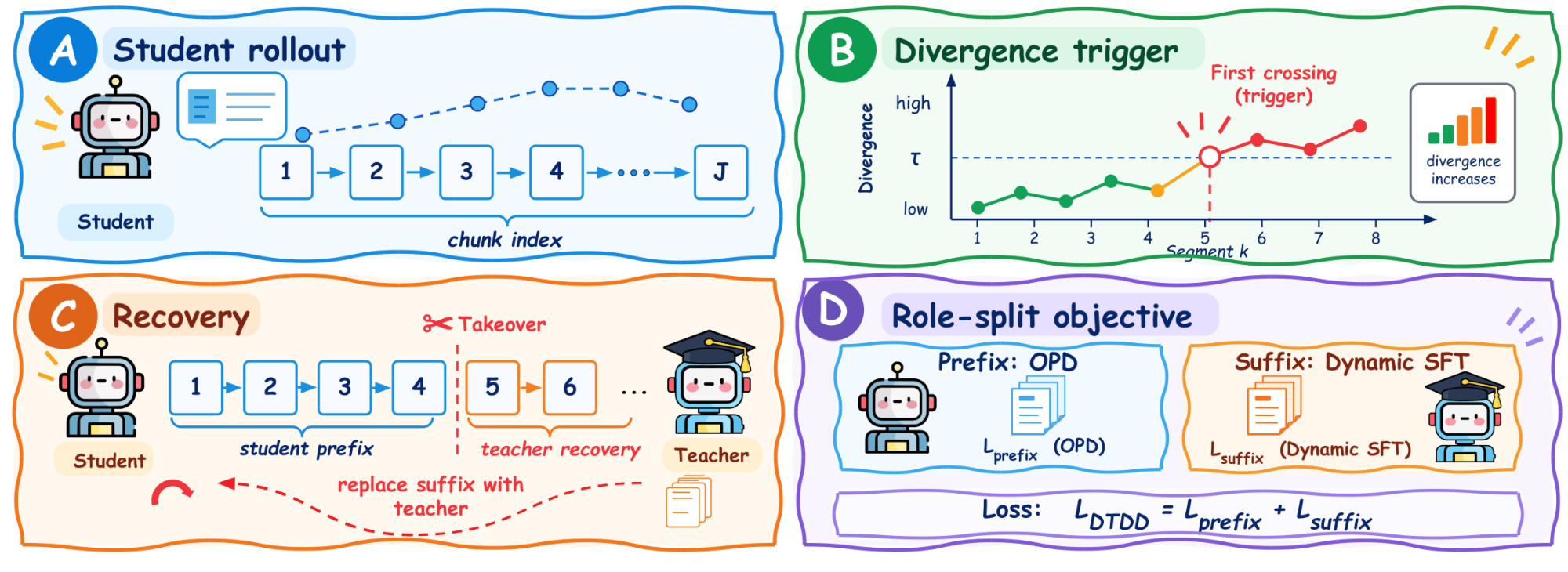
Reasoning realization of DTDD. The teacher recovers from the retained student prefix. View full size ↗Swipe to explore the plot on mobile.

Abstract

On-policy distillation (OPD) provides dense token-level supervision on student rollouts, but this supervision can become unreliable when the student and teacher diverge, either because of a large initial policy gap or compounding errors in long-horizon reasoning and tool use. We introduce Divergence-Triggered Dynamic Distillation (DTDD), an adaptive OPD framework that routes supervision between standard OPD and teacher-generated recovery using segment-level student–teacher divergence. When divergence triggers an intervention during reasoning, the student prefix continues to receive standard OPD supervision, and the teacher generates a recovery suffix that the student learns through behavior cloning, an online SFT-style loss.

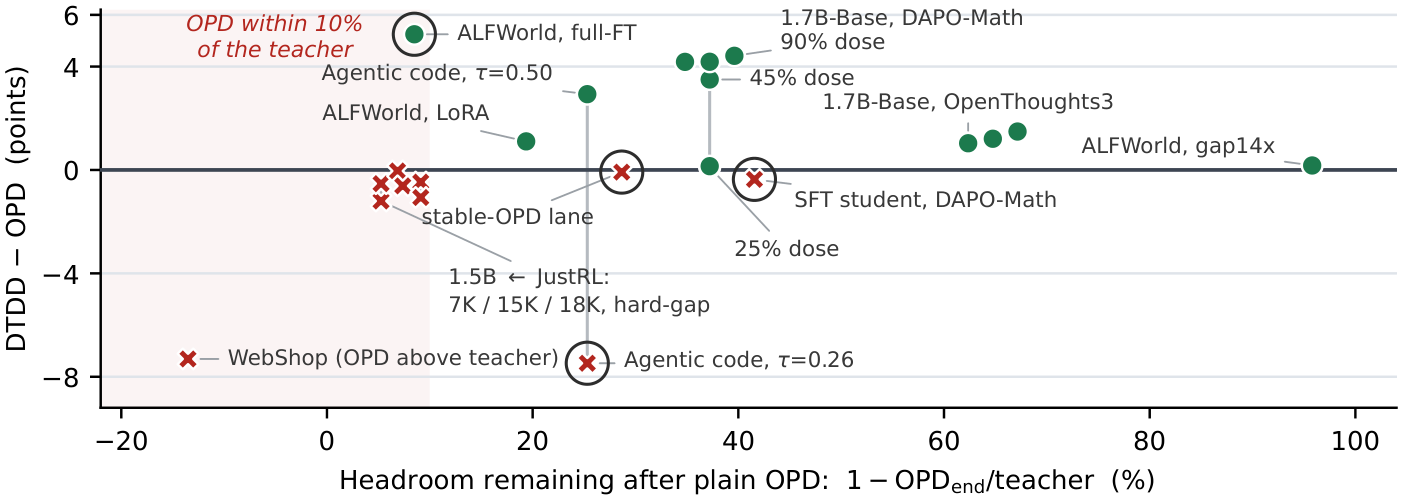
We evaluate DTDD in long-horizon reasoning, distillation from a base initialization without offline SFT, and multi-turn agents, and compare alternative trigger designs and teacher-intervention rates. DTDD reduces the post-warm-up peak gradient norm by 8.6×. From a base initialization, it reaches the 21.3% held-out math accuracy reference level in 2.6× fewer optimizer updates than OPD; both methods later reach around 22%. It improves best-observed performance by 4.8 and 4.1 points on ALFWorld with LoRA and agentic code. In the tested controls, segment-level triggers outperform token-level triggers, and behavior cloning trains teacher-generated recoveries better than applying the student-top-K OPD surrogate to those suffixes. Across 23 experimental arms, teacher headroom is a useful empirical diagnostic, with teacher validity, student learnability, and intervention dose explaining the principal boundary cases.

Method

On-policy distillation (OPD) trains on student-generated trajectories using teacher feedback. DTDD adds a simple switch: keep OPD on the student prefix; learn a teacher-generated recovery suffix through behavior cloning, the usual cross-entropy loss on teacher tokens.

  1. A. Student rollout. Generate a response and divide it into fixed-length token windows.
  2. B. Divergence trigger. Average the student–teacher log-probability gap within each window and compare it with a threshold.
  3. C. Teacher recovery. Retain the student prefix and regenerate from the start of the triggering window.
  4. D. Role-split training. OPD trains the prefix; cross-entropy trains the recovery suffix. No trigger means ordinary OPD.
How does this work for agents?

A segment becomes a model-generated action. In agentic code, the teacher replaces the triggering action and completes the rest of the episode. In ALFWorld and WebShop, the teacher replaces only that action, and the student resumes at the next turn.

Agentic code uses behavior cloning on teacher-written tokens. ALFWorld and WebShop retain their existing sampled-token OPD surrogate on replacement actions, giving imitation weighted by the student–teacher log-probability gap.

Why can token-level OPD feedback be insufficient?

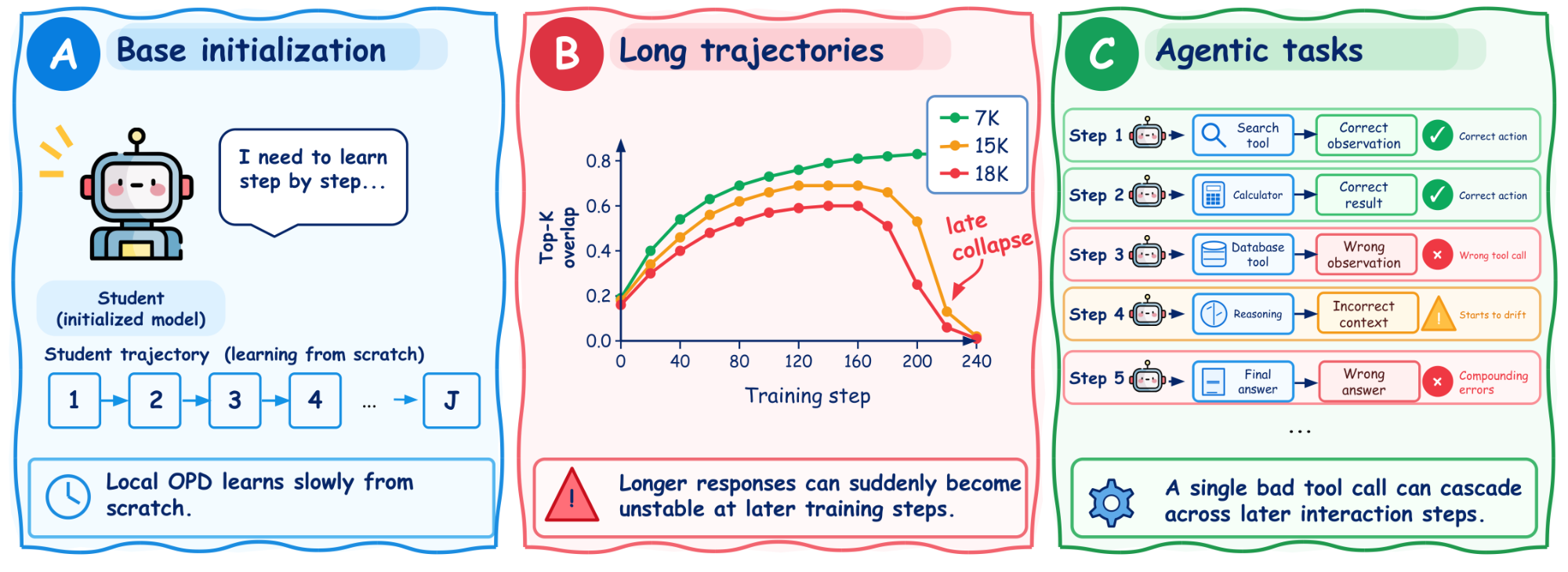
A base student may need coherent demonstrations to acquire a compatible reasoning pattern. Long reasoning can become unstable, and an incorrect tool call can change all later observations. Local teacher feedback on the resulting trajectory may no longer be enough to show the student how to recover.

Examples motivating teacher recovery: a large initial policy gap, long reasoning trajectories, and errors that propagate through tool use. View full size ↗Swipe to explore the plot on mobile.

Experimental Results

We study when teacher recovery stabilizes training, accelerates learning from a base initialization, and helps interactive agents.

Long-horizon stability

Student R1-Distill-1.5B · Teacher JustRL-1.5B · Data DAPO-Math-17K

With 15K- and 18K-token response budgets, DTDD suppresses the late gradient spikes seen in OPD while keeping held-out accuracy within one percentage point.

Peak gradient norm decreases from 12.02 to 1.40 at 15K and from 12.81 to 1.84 at 18K.
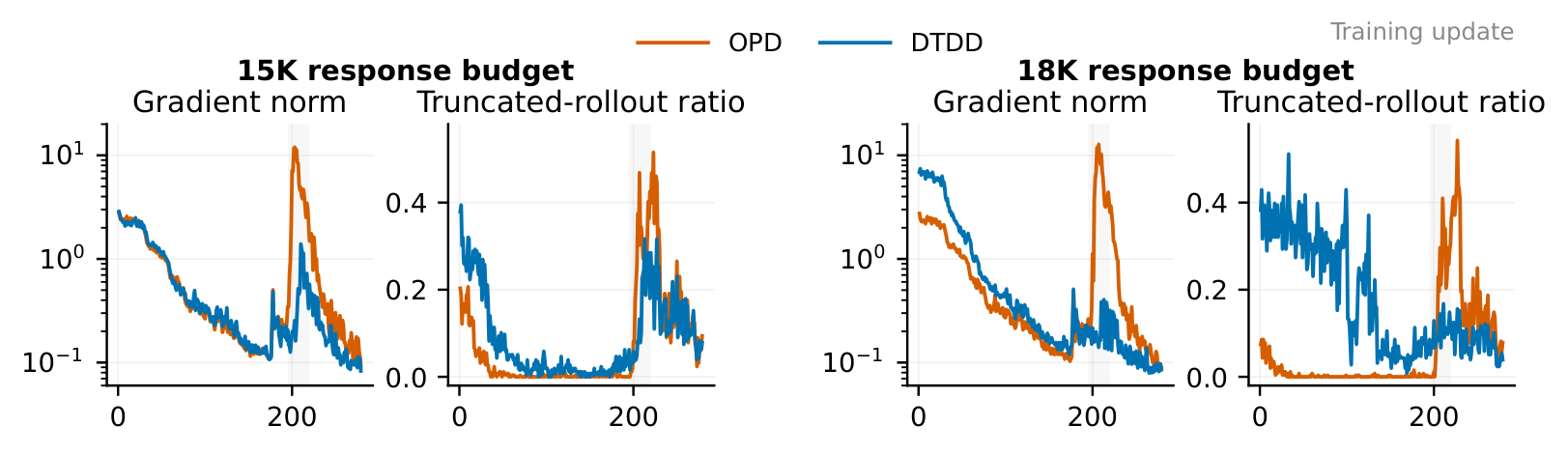
DTDD suppresses late OPD spikes at 15K and 18K response budgets. View full size ↗Swipe to explore the plot on mobile.
Measurement and stability controls

The full model names are DeepSeek-R1-Distill-Qwen-1.5B and JustRL-DeepSeek-1.5B. Peak gradient norms are measured from update 51 onward, after the initial optimization transient. The 7K response-budget setting serves as a stable OPD control.

Clipping the per-token OPD signal to [−1, 1] also stabilizes these runs. This control shows that teacher recovery is one way to suppress the late optimization event; it is not required for stability alone.
Learning from a base initialization

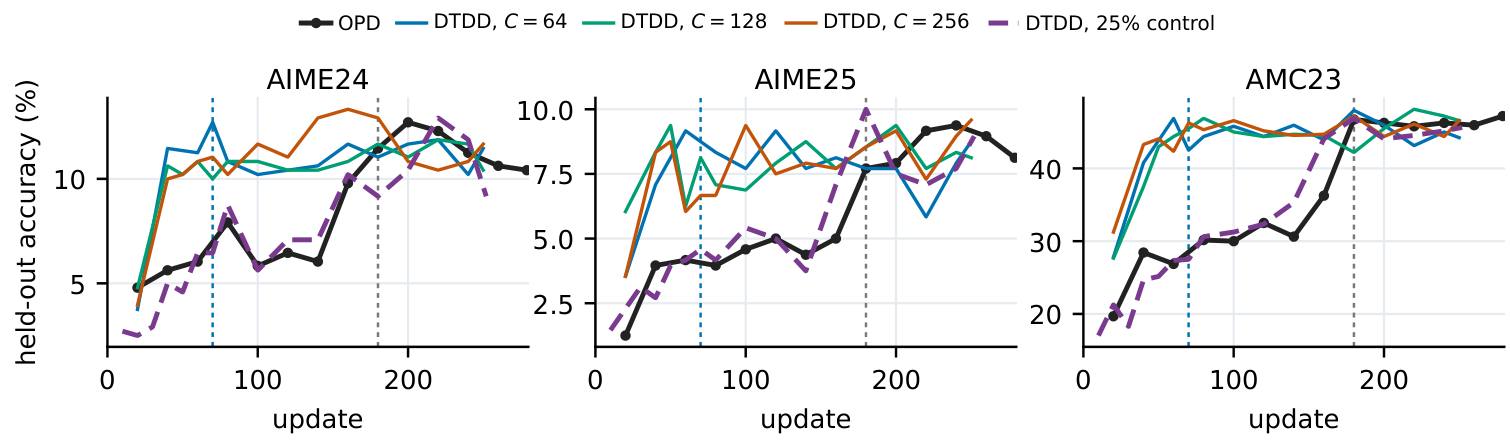
Student Qwen3-1.7B-Base · Teacher Qwen3-4B-Base-GRPO · Data DAPO-Math-17K

With frequent teacher intervention, DTDD reaches the 21.3% held-out accuracy reference level near update 70, compared with approximately 180 for direct OPD. Both later reach around 22%: the gain is in how early the student learns.

Accuracy on AIME 2024, AIME 2025, and AMC 2023, averaged across benchmarks using average@16 evaluation. View full size ↗Swipe to explore the plot on mobile.

One training stage, no offline SFT pipeline

DTDD reaches comparable accuracy with fewer teacher-written tokens and less measured serial time than generating a teacher dataset, running SFT, and then training with OPD: 22.0 versus 42.8 hours and 43M versus 95M teacher-written tokens.

What is being compared?

The 2.6× comparison counts optimizer updates against direct OPD, not elapsed time. The serial-time comparison is a separate run: DTDD reaches 21.34% at update 80 in 22.0 hours; the offline SFT-then-OPD pipeline reaches 21.55% at update 20 in approximately 42.8 hours, including data generation, SFT, checkpoint merging, and OPD.

The offline stages use A40 and A100 GPUs; this DTDD run uses four L40S GPUs. These are measured pipeline times, not hardware-normalized compute savings: the corresponding totals are approximately 66 and 88 GPU-hours. The 95M and 43M figures count teacher-written tokens, not teacher scoring of student tokens.

The figure compares different token-window sizes and intervention controllers. Its fixed-threshold control starts around 25% takeover and adapts thereafter; it is not a constant 25% rate. The reasoning implementation generates the full student response before choosing the teacher recovery boundary, so takeover does not save student rollout computation.

Multi-turn agents

ALFWorld with LoRA

Student Qwen2.5-3B-Instruct · Teacher GiGPO-7B

Best-observed average success over the seen and unseen splits increases from 76.49% to 81.32%.

Agentic code

Student Qwen3-1.7B-SFT · Teacher DemyAgent-GRPO-4B · Data Open-AgentRL-30K, code subset

Best-observed accuracy averaged across four evaluation splits increases from 36.49% to 40.59%.

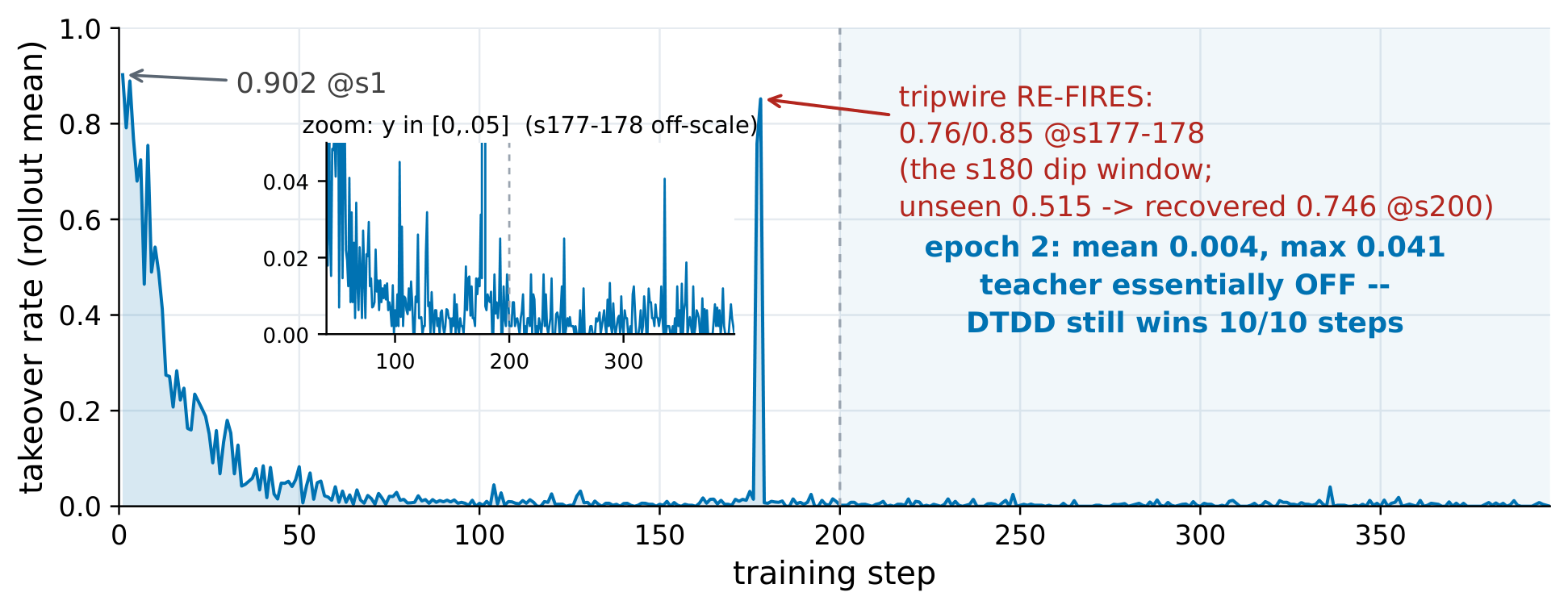
In ALFWorld, takeover falls from about 90% to near zero as training progresses, then reactivates around update 180. In agentic code, a sparse 2.8% teacher-token share improves all four splits at the selected best checkpoints.

ALFWorld with LoRA: takeover becomes sparse and reactivates near update 180. View full size ↗Swipe to explore the plot on mobile.
Evaluation splits, selected checkpoints, and controls

Best-observed results select one checkpoint per method by the average across complete evaluations. ALFWorld uses updates 280 and 140 for OPD and DTDD; code uses updates 80 and 60. Code averages HO-200 full, HO-200 subset, LiveCodeBench v1, and LiveCodeBench v6.

At the last shared ALFWorld checkpoint (400), success is 70.06% for OPD and 77.59% for DTDD. Under full fine-tuning, the best-observed gain is smaller: +0.34 percentage point, compared with +4.83 with LoRA.

At the last shared code checkpoint (130), the four-split average is 33.93% for OPD and 34.96% for DTDD. The two LiveCodeBench splits average 42.26% and 38.43%, respectively; the held-out code splits average 25.60% and 31.50%. The best-observed and endpoint views therefore answer different questions about training.

Design Controls

We vary two choices: whether takeover is triggered by a segment average or a token spike, and whether teacher-written tokens receive cross-entropy or the OPD surrogate. The segment-triggered, cross-entropy combination performs best among the tested online variants at updates 60–120.

Held-out math accuracy (%) at update 120
TriggerTeacher suffix: cross-entropyTeacher suffix: OPD surrogate
Segment average20.83 · DTDD10.23
Token spike16.7913.51

Same base-student DAPO setting as above. Direct OPD: 14.54%. DTDD and OPD are two-seed means; other variants are single runs.

Complete comparison, including AdaSwitch and offline SFT
Average@16 (%) over AIME 2024, AIME 2025, and AMC 2023
Trigger / methodSuffix lossStep 6080100120Teacher tokens / update
OPD—12.1414.0013.1514.540
DTDD (segment)Cross-entropy20.3221.4721.0820.830.52M
Token spikeOPD surrogate12.4712.1412.8113.510.40M
Token spikeCross-entropy13.1913.0713.2616.790.43M
SegmentOPD surrogate5.787.808.0410.230.67M
AdaSwitch (relative 3×)OPD surrogate18.1619.5718.6819.950.86M
Offline SFT then OPD—20.6322.8122.4522.030 online

OPD and DTDD are two-seed means; other rows are single runs. Teacher tokens count generated continuation tokens. Offline SFT uses an additional 95M teacher-written tokens before OPD.

Cross-entropy is behavior cloning on the actual teacher-written token. The OPD-surrogate controls instead use the student-top-K distillation surrogate on both the student prefix and teacher suffix. This changes the target support as well as the loss, so the result concerns this specific surrogate rather than all forms of distribution matching.

The token-spike controls use a history-normalized spike score. AdaSwitch is a separate reproduction: its token-level trigger fires when divergence exceeds three times the preceding ten-token mean. It comes closest to DTDD in this comparison and uses approximately 1.7× as many teacher-written tokens per update.

When Does Takeover Help?

Across 23 arms in 13 settings, 19 follow a common pattern: takeover tends to help when the teacher still outperforms the OPD-trained student. That gap is informative, but a larger gap does not guarantee a larger gain.

Each point is an experimental arm. Gains are averaged over shared checkpoints; they are not the best-observed scores reported above. View full size ↗Swipe to explore the plot on mobile.
How to read the headroom plot

The horizontal axis is normalized teacher headroom, 1 − (OPD endpoint performance / teacher performance). The vertical axis is the DTDD-minus-OPD difference averaged over shared checkpoints. This is a retrospective empirical diagnostic, not a calibrated rule for choosing a threshold or predicting gains.

The central mechanism is online routing: segment-level divergence determines where teacher recovery enters training. In the base-student experiments, early accuracy gains come from sufficient coherent teacher supervision.

Citation

@misc{he2026dtdddivergencetriggereddynamicdistillation,
  title={DTDD: Divergence-Triggered Dynamic Distillation for Reliable On-Policy Supervision},
  author={Qijia He and Zequn Li and Spencer Luo and Tianle Chen and Pradyumna Narayana and Zixian Ma and Ranjay Krishna and Lan Nie and Sugato Basu},
  year={2026},
  eprint={2610.19302},
  archivePrefix={arXiv},
  primaryClass={cs.LG},
  url={https://arxiv.org/abs/2610.19302},
}

Figure

Open original ↗